Moisture Detection and Leak Location in Costa Mesa, CA
Moisture detection and leak location in Costa Mesa answers the two questions that decide the whole job: where is the water coming from, and how far has it already gone. Those are separate questions with separate tools, and getting either wrong is expensive.
It matters most in the cases where there is nothing to see. A rising water bill with no visible leak, a smell in one room, a patch of floor that is warm, a wall that stays cool and damp. Guessing at those means opening finishes until something turns up.
Two Different Jobs: Finding the Source and Mapping the Spread
Leak location finds the failure. Moisture mapping finds the extent. They are routinely confused, and a job that does one without the other goes wrong in a predictable way.
Find the source without mapping the spread, and the leak gets repaired while a wet area is sealed up behind new finishes, which reappears weeks later as staining or a smell. Map the spread without finding the source, and the building gets dried properly and then gets wet again, because whatever caused it is still running. Both are done before anything is cut.
The distinction also explains why the wet area is almost never centred on the leak. Water runs along framing, follows the top plate of a wall, drops through the first penetration it finds, and spreads laterally under floor finishes. The visible evidence marks where it emerged rather than where it started, which is why the hole cut under the stain so often finds nothing.
What the Equipment Does
- Pin moisture meters, which read conductivity between two probes pushed into the material and give a direct reading of that spot. Accurate, and they leave small holes
- Pinless meters, which read a shallow depth non-destructively through a finish and are used to scan an area quickly before confirming with pins
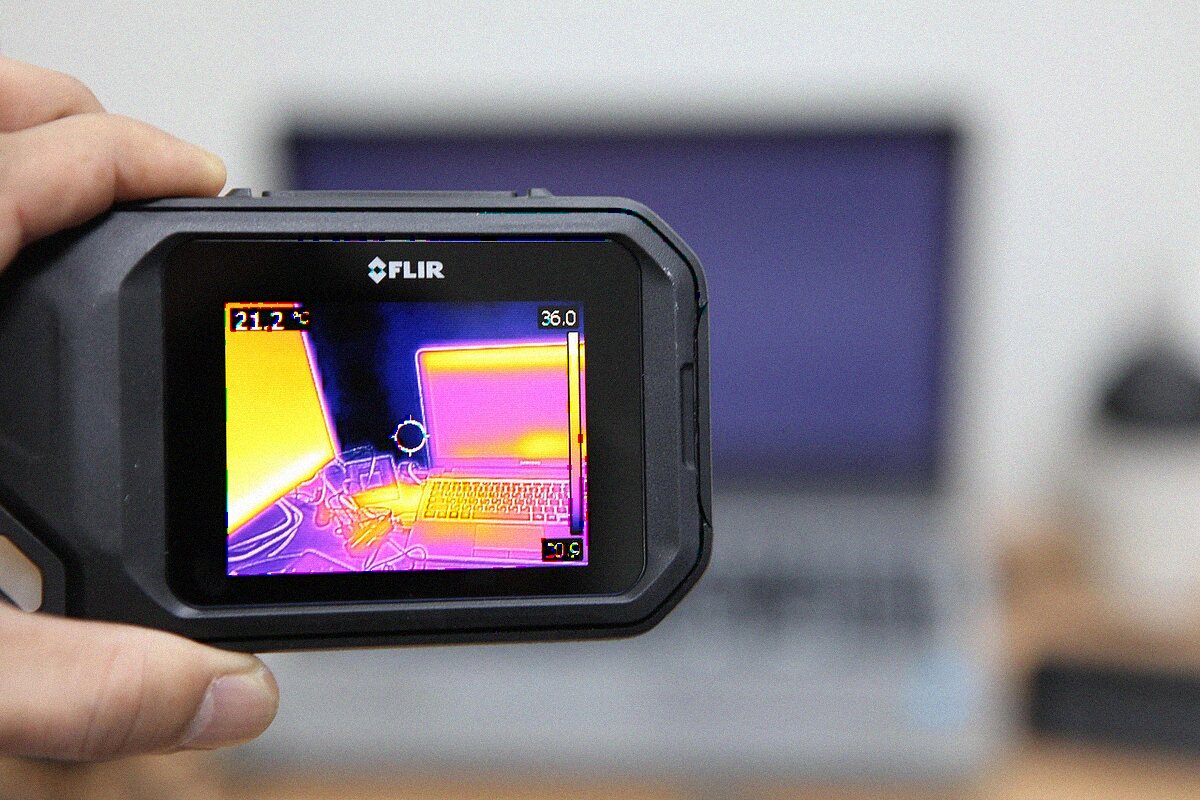
- Thermal imaging cameras, which show surface temperature rather than moisture, revealing the cooling effect of evaporation or the warmth of a hot water leak. They indicate where to measure rather than proving water is present
- Hygrometers and thermo-hygrometers, which read air temperature and relative humidity to calculate the drying capacity available and monitor the chamber
- Acoustic listening equipment, which detects the sound of pressurised water escaping through concrete or behind a finish
- Borescopes, which inspect inside a wall or floor cavity through a small hole rather than opening the assembly
- Tracer gas, where an inert gas mixture charged into the system escapes through the failure and is detected at the surface
The most important limitation is thermal imaging, because it is the most impressive-looking and the most frequently misrepresented. A thermal camera does not see moisture. It sees temperature difference, and cool areas can equally be a draught, a missing patch of insulation, a cold water pipe or a structural thermal bridge. It is an excellent tool for deciding where to put a meter, and a meter reading is what establishes that a material is wet. Anyone presenting a thermal image on its own as proof of water is overstating what the equipment does.
When It Is Worth Paying to Investigate
There are a few situations where investigation pays for itself several times over. The clearest is a suspected slab leak, because locating a failure precisely means opening the floor in one place rather than exploring. On tile or hardwood over slab, that single decision often exceeds the cost of the entire investigation.
The second is a recurring stain that has been repaired before. A patch that has been repainted twice is a diagnostic failure rather than a decorating problem, and the cause has not been found. The third is buying or selling a property, where establishing whether a stain is historic and dry or active and wet changes the negotiation, and a meter reading answers it in minutes.
The fourth is a disagreement about how far the damage extends. Where somebody has scoped a smaller area than the readings support, documented moisture measurements across a mapped grid are the evidence that settles it. That is a considerably stronger position than a description.
The Costa Mesa Specifics
Slab-on-grade construction, which is the norm for the city's postwar tract housing, makes detection more valuable than it would be on a raised floor. There is no crawl space to inspect and no underside to see, so a leak beneath the slab has to be located through the concrete rather than looked at. Water spreading between the slab and the flooring also has nowhere to drain, so it travels laterally under the finish and stays, which means the mapped wet area is frequently much larger than any visible sign.
The city's housing age raises the base rate for the leaks that need finding. Census estimates put roughly 68 percent of Costa Mesa housing as built before 1980, so original copper at pinhole age is common, and pinhole leaks are specifically the kind that release very little water very slowly. That is the profile that runs for months inside a wall or under a floor without producing anything visible, and it is the reason a rising water bill is worth investigating rather than dismissing.
Tell Us What Has Happened
The line is answered 24 hours a day, every day of the year. If water is still running, shut off the main first, then call.
Why Costa Mesa Property Owners Choose Us
Thermal Imaging Points, Meters Prove
A thermal camera reads surface temperature rather than moisture, and cool patches are just as often a draught, missing insulation or a cold pipe. It is used to decide where to measure, and a meter reading is what establishes that a material is wet. Presenting a thermal image on its own as proof of water overstates what the equipment does, and it is worth knowing that when anyone shows you one.
The Source and the Spread Are Both Established
Finding the leak without mapping the wet area seals moisture behind new finishes. Mapping the wet area without finding the leak dries a building that then gets wet again. Both questions are answered before anything is opened, which is also what keeps the demolition proportionate rather than exploratory.
Investigation Before Demolition Is Usually the Cheaper Order
On tile or hardwood over a slab, locating a leak precisely so the floor can be opened in one place routinely costs less than the flooring that exploratory openings would consume. Where a stain has already been patched and repainted more than once, the unresolved question is diagnostic rather than cosmetic, and repainting it again is the more expensive option.
A common call about a stain that keeps coming back
The situation: a wall patch in a Costa Mesa house that had been cut out, replaced and repainted twice over about two years, reappearing each time within a few months. Both previous repairs had assumed a roof leak.
What gets done: pinless scanning across the wall and the adjoining floor to establish the wet area, then pin readings to confirm, and thermal imaging to look at the temperature pattern behind the finish. The wet zone extended downward rather than from above, which pointed away from the roof entirely. Acoustic listening located a pinhole in the original copper supply running in the wall base, and a borescope confirmed it through a single small hole rather than by opening the wall.
The result: the actual cause is identified after two repairs had addressed the wrong thing, the third repair is the last one because the leak is gone, and the wet extent is mapped so the drying covers the area that is genuinely wet instead of the size of the previous patch.
Before you sign anything, know the warning signs
A short guide to the things that separate a straight operator from a bad one in this trade, plus how to check a California contractor licence in about two minutes.
Frequently Asked Questions
Can you find a leak without breaking anything?
Usually the location can be established non-destructively, using pinless meters, thermal imaging, acoustic equipment and where needed tracer gas. Confirming a reading sometimes means pin probes, which leave pinholes, or a borescope inspection through a small hole. The point of the investigation is that the repair opening is then made once, in the right place, rather than exploratively.
Is thermal imaging able to see through walls?
No, and it is worth being clear about that because it is often implied. A thermal camera reads the temperature of the surface it is pointed at. Moisture shows up indirectly, through evaporative cooling or the warmth of a hot water leak, and plenty of other things produce the same signature, including draughts and missing insulation. It is a targeting tool, and the meter is the measurement.
My water bill went up but I cannot find a leak. What now?
Start with the meter test, which costs nothing: shut off every fixture and appliance that uses water and watch the meter. Movement means water is leaving the system. On a slab property with no visible water that points toward an under-slab supply leak, and locating it is the next step. A rising bill with no visible cause is one of the clearest indications that investigation is worth doing.
Related Services
Water Damage Restoration
Full water damage response for Costa Mesa homes, from the first extraction pass through to drying, clearance and repair.
Read more →Slab Leak Water Damage
Under-slab supply leaks in the slab-on-grade housing that dominates Orange County, located without opening the whole floor.
Read more →Ceiling Leak Water Damage
Brown rings, sagging drywall and the upstairs bathroom that has been leaking quietly for weeks.
Read more →Structural Drying and Dehumidification
Air movers and refrigerant dehumidifiers sized to the room, with daily moisture readings until the structure is genuinely dry.
Read more →See all 14 water damage services, or start from the Costa Mesa water damage overview. Background on how the business works is on the about page.